Wednesday, August 31, 2011

The Secret of Success


The NonProfit Times, Aug. 1, 2011. Reprinted with permission.
If you ever want to mount a case against religion, don’t bother trying to solicit testimony from American non-profits. According to a June 2011 survey of U.S. adults by The NonProfit Times, those who give to religious organizations are the top supporters of secular ones, as well:
• Forty-seven percent of those interviewed contribute to religious groups.
• People who donate to religious causes are three times more likely to donate also to secular causes than are those who never support religious charities.
• Where age is a factor, the highest disparity between those who give to religion and those who do not is in the 18- to 34-year-old bracket: 23%. Eighty-two percent of these young adults who give to religion also support secular causes, compared with 59% of those who expressed no interest in giving to religion.
• Consistently, among all ages, educational backgrounds, and household incomes, religious donors support more than one other charity. Two of the most dramatic differences occur in the age and education categories: 11% of religious donors of all ages give to between six and ten organizations annually, compared with 4% among the non-religious; and 25% of those religious donors who never finished high school give to more than ten, compared with 4% among the non-religious.

In addition, basing itself on IRS estimates for giving, Giving USA Foundation reported that the cause which U.S. adults supported most in 2010, was religion: 35% of the nearly $300 billion that Americans donated, followed by education at 14%. 

If that isn’t enough to upend preconceived notions, here’s another. Giving USA also recently published a study entitled, “Charitable Giving and the Millennial Generation,” 
that highlights giving patterns in “Millennial” donors—adults born since 1981. It states: “As with earlier generations, Millennials who give contribute the largest share of their dollars to religion. There has been a lot of information reported on the secularization of America, so this could be a countering trend” (Una Osili, Ph.D., director of research at the Center on Philanthropy).* Joanne Pong’s story, featured in the August 17 post of this blog, is a case in point.

Why this interest among our youngest adults? I spoke with Melanie McKitrick, one of the two researchers and authors of the study, who told me that while only 16% of Millennials preferred faith based giving in 2006, for example, it was a significant preference: three times more in contributions than to secular purposes. As with other demographics, Millennials who do give tend to have a steady income, are married, and have already graduated from college. Part of establishing themselves and raising a family is connecting with a faith community they can commit to, and a concrete part of that commitment consists of nearly $800 in donations annually.

In 2010, donors often gave to trusted umbrella groups that distribute funds among those they serve, for example the United Jewish Fund or Catholic Charities. Catholic Relief Services and other religious organizations ministered in the aftermath of Haiti’s earthquake last year—a key humanitarian cause for many donors in the U.S., religious and otherwise. Melanie acknowledged that it’s not yet possible to determine donors’ reasons for choosing charities, but she agreed that it’s very likely that not only Millennials, but other demographics made at least some of their religious contributions through this cause.

That said, it’s also true that people of faith tend to see God, not only in clearly religious settings, but also in what appears ordinary, even banal. As one man told me last week, “We should be able to hear the Word of God when we dig a hole in the garden and plant a flower.” From the Christian perspective, the Incarnation of God’s Son carries precisely this message. Nothing truly human is off limits for the divine.

So for these same people of faith, donating to charity, whether strictly religious or purely humanitarian, is an act of faith—whether they call it that or not. “It’s a good cause” means exactly that, since every good comes from God. Larry May at infogroup, which helped in carrying out The NonProfit Times survey, commented, “It might feel like our country is becoming more secular, but it’s not the case for these donors.”**

Against the current economic backdrop, that faith-in-action evidently moves such people to give even “until it hurts.” If my parents are any indication of the spirit behind this kind of giving, people of faith feel that God has been very good to them and will continue to care for them. In our house, you didn’t throw the scraps to God. I remember my father in particular saying, “We’re not rich, but we have a roof over our heads and food on the table. Everything we have comes from God, and it’s on loan to us to use as he wills. It’s up to us to find someone to share God’s blessings with, because they came from him.” This attitude is what motivated both my parents to give their blessing to both their daughters—their only children—when we chose religious life.

Mosaic rendering of the emblem worn by every
Daughter of St. Paul
This is the spirit behind what has become known in the Pauline Family as the Pact or Secret of Success. This “Pact” was first made between Fr. James Alberione and Fr. Timothy Giaccardo as one party and—upon what they felt was God’s invitation—the Holy Trinity as the other. Alberione and Giaccardo took seriously Jesus’ words in Mt. 6:33 and literally drew up a “deal” with God: “Seek first the kingdom of God and his holiness” (here they signed their names), “and all else will be given you besides” (here they wrote “the Father, Son, and Holy Spirit”). It was based both on their prophetic intuition regarding the responsibility they felt for evangelizing the world according to God’s call, as well as their trust in God’s liberality in giving these first members the help they needed to be saints and to carry out that mission.

That help certainly included material goods. In a talk, though, to the members on the feast of St. Paul’s Conversion in 1919, Fr. Alberione—“full of conviction and persuasion,” as Fr. Giaccardo recalls the founder that night—was quick to point out that their trust had to extend far beyond the material: “Our House lives on Providence. The greatest offense that God receives from our House is lack of trust in Him. He shows that it is he who does all things; we are stupid not to trust him….We must go before Jesus and tell him not to fail in his promises….Clear pacts and trust. The apostles were ignorant, but once they received the Holy Spirit, they amazed the world, confounded the learned, and enlightened everyone. This faith is essential to the spirit of the House; as the spirit is new, so it possesses new means. We must work for God and we need to know many things. So we work and the Lord takes care of providing our food, food not only for the body, but also for the mind and the heart….”

The Pact went through various revisions even during the founder’s lifetime. Here it is in its present form:
The Secret of Success     Jesus Master, accept the pact that we present to you through the hands of Mary, Queen of the Apostles, and of our Father, St. Paul.
  
We must correspond to your sublime will, arrive at the degree of perfection and heavenly glory to which you have destined us, and perform the apostolate of social communication in a holy manner. But we see that we are very weak, ignorant, incapable and inadequate in every way: in spirit, in knowledge, in the apostolate and in poverty. You instead are the Way and the Truth and the Life, the Resurrection, our one and supreme Good. We trust in you alone who said: “Whatever you ask the Father in my name, you will receive it.”
  
For our part, we promise and commit ourselves to seeking wholeheartedly in all things, in life and in the apostolate, only and always, your glory and peace to all peoples. We trust that on your part, you will give us a good spirit, grace, knowledge, and the means for doing good. According to your immense goodness and the needs of our special vocation, multiply the fruits of our spiritual work, of our study, of our apostolate, and of our poverty. We do not doubt you, but we fear our inconstancy and weakness.
  
Therefore, good Master, through the intercession of Mary, our Mother, extend to us the mercy you used with the Apostle Paul so that, faithful in imitating our father here on earth, we may be his companions in the glory in heaven. Amen.

Ed Robinson, president of NCCF, and
Paul Zambernardi, Raskob Foundation
One unique organization that facilitates this kind of giving is the National Catholic Community Foundation. NCCF believes that donors are looking to endow their favorite charities within the Catholic community, choosing long term growth over short term goals or projects. So it structured itself as “a pool of individual, perpetually created funds,” such as donor-advised or donor-designated funds, as well as field of interest funds, either in the name of specific Catholic non-profits or as vehicles for funding ministries according to donor intent. In this way, it hopes to assist Catholic non-profits in gathering “onto the bridge we provide between philanthropy and deserving Catholic ministries” (Richard J. Dowling, NCCF trustee). 

We learned of their services when an anonymous donor, a couple actually, decided to establish a small endowment of $400,000, called the “Daughters of St. Paul Fund” to support the life and works of our religious congregation. They wanted their contribution to begin doing good, and at the same time, continue to grow, both through investments made by the NCCF and through additional contributions from others who feel inspired to share in our mission in this way. So the fund was established to accomplish both goals, allowing our community to access a minimum percentage each year, while continuing to grow the principal. No contribution is too small. Click on the hypertext above or call the NCCF at 1-800-757-2998 to learn more.

____________
“Charitable Giving and the Millennial Generation,” by the Center on Philanthropy at Indiana University. Reprinted with permission.
“Religious Donors Give to Secular Groups Too.”
The NonProfit Times, Aug. 22, 2011. Reprinted with permission.

Wednesday, August 24, 2011

Discover Hope

Even if you’ve never come up with one, you know what a tagline is. Recognize these? “Just Do It.” “That Was Easy.” “It’s All Inside.” Taglines synthesize values, express company commitment, and ensure brand recognition. Memorable ones resonate on a level deeper than commerce or sentiment and drive markets into their companies’ corner. For this reason corporations pour millions into clinching the mother of all catchphrases.

In crafting its new tagline, Pauline Books & Media meditated instead. As individuals and as small groups of sisters and co-workers, Pauline Cooperators and friends, we began a year ago to ask ourselves what makes us who we are: What are people looking for when they turn to us? What do we value and how do we communicate that? What message do we want to convey that says “Gospel” to the people of today?

Thus was born “Discover Hope.” We believe that Jesus Christ is the ultimate reason for our hope, and our mission exists to bring people into conversation and relationship with him by entering into conversation with them, building community with them. It may be through one of our media products or services or through our own witness as his disciples. No small task, but that gives us reason to live in hope too! In fact, one of the first steps in deciding upon this tagline was the realization that “we are meant to be the first encounter with Christ that each person experiences when coming into contact with us; we are meant to be the communication of Christ" (Sr. Margaret Timothy Sato). We may stammer or blur the image in the process, as everyone does, but we can’t stop communicating. “When they see our logo, they will feel like they’ve just pulled up in the driveway of their best friend” (Sr. Leonora Wilson, superior of the US/ESC province).

Whom are we trying to reach in this way? Sr. Margaret Timothy, the provincial superior at the time of the internal launch, named them clearly: “a much wider audience than we presently reach—the broader, and for the most part, unchurched audience that is the vast majority of our population.”

How does the tagline do this? What are we saying by the process? Again Sr. Timothy points out: “we are revitalizing ‘Pauline’ as a name that identifies all of who we are and what we do in mission…. In reflecting on ‘Discover Hope,’ four key attributes emerged that articulate this well, elements that we have long recognized as characteristic of our mission, and therefore of Pauline.” They are elements that “describe our values [and] express how people have benefitted from us over the years. The four attributes of our branding statement—PASSIONATE, TRUSTED, JOYFUL, and SANCTUARY—are promises we can make to the people we are called to minister to…. what we are known for.  These qualities are found in our community’s Constitutions and they express what we strive to be for the people we serve.

Sr. Margaret Timothy plays and
directs at the Jubilee Mass last
Saturday.

“We are PASSIONATE – “We invest our whole lives to bring the Gospel of hope to people yearning for God’s love.” This is the gift and privilege of our total belonging to Christ! ‘We will use any form of technology to proclaim God’s message in the best way possible.’”

The second key element is that for generations we have been TRUSTED by others in the area of life they most wonder about or that is most precious to them—their faith. Fidelity to our mission, like fidelity to our consecration, means we can communicate to the people of our society, “You can trust us to be your authentic resource for books and media solidly rooted in our Catholic identity.”

Sr. Fay and Sr. Nazarene
A third element which describes us as Paulines, “We are JOYFUL—In whatever venue you find us, we will welcome you with joyful hearts.” Both our founder and co-foundress point out to us the joy that should characterize our lives, a joy that was often captured in photos of them. It was the joy of the sisters that drew many of us to our community and that still invites young women today.

Sr. Tracey and Sr. Anne Joan
cantor the responsorial psalm.
Sr. Margaret Timothy concluded, “The fourth element descriptive of our Pauline mission is that wherever we meet people, and in whatever context, we know that the encounter is sacred. We are a SANCTUARY. The communication—of our words, actions, gestures, and silences—because we are sincerely striving to live Christ, provides a sanctuary for others. We communicate to the people we meet, ‘in encountering me, you can ‘encounter God.’ And it is God ‘who gives [to all of] us wholeness and meaning.’”

At first glance, it would seem we’re still addressing those we have addressed for years. To some extent we are; we don’t want to abandon them either! But if these, if you, can capture some of what we’re promising, if you can be “passionate, trusted, joyful and a sanctuary” for many we may not reach directly, Jesus Christ can be proclaimed to those many, as well. We are inviting you to be ambassadors of Christ like Paul. It can sound strange, but in a very real sense, together with you we need to “be” the brand—because by our Christian vocation we are all meant to be Christ who is our hope. So whether you access our new Web site, walk into a PBM Center, share your story of hope on the Discover Hope Facebook page, give a PBM media gift to someone, donate to a Pauline project (see the “Donate” button on the right sidebar), or pray for this mission, you can be a Pauline ambassador of hope!

But even directly, the unchurched can discover hope through Pauline media. These four characteristics are primarily our commitment to proclaim “peace to those far off [from faith] and peace to those nearby” (Eph. 2:17). “Today’s digital media give us the best opportunity we have ever had to give the Gospel to every person. As the number of cell phones in our nation approaches the number of teenagers & adults in our nation, we genuinely have the possibility of reaching our GOAL—to place the Gospel in everyone’s hands, and even more importantly, in their hearts” (Sr. Margaret Timothy).

We had our own internal tagline launch in the spring and planned the public launch to coincide with the anniversary date of our founding as a Pauline Family—August 20. It just so happens that the launch also coincides with the start of the triennium—or three years of preparation—leading up to the centenary of our founding in 2014. In addition it coincided with seven other anniversaries—those of four sister silver jubilarians, one golden, and two diamond. Sisters Marie James Hunt, Marie Bernard Tran, Jane Raphael Livingston, Sean Marie David, Mary Mark Wickenhiser, Mary Paula Kolar, and Mary Louise Oddi celebrated and reaffirmed their commitment to incarnate Christian hope and to be hope for the culture of communication.

It was a wonderful day! Of course families and friends joined the community in pulling out all the stops: Liturgy, flower arrangements, music, preaching, food, décor, and more tell something of our love for these sisters and of the sign they are for us all.

Decades of fidelity are impressive. So I asked some of them to share the “secret” of their fidelity. “I know,” I said, “the grace of God. So now that we’ve established that, what is it—an attitude, a practice, whatever—that is yours personally, that has made the grace of God fruitful in your perseverance?”

Sr. Jane responds, “God is full of surprises. Expect the unexpected. When the reality that ‘Nothing is impossible for God’ meets with our willingness to trust, the recipe for miracles is present, and the rest is history.”

Then I ask Sr. Mary Mark. Her laugh tells much…and has you guessing at the rest! Sincerely, though, she answers with a memory that stretches back to her earliest years of formation. “Since I was a postulant, I have prayed the Pact* every day of my life. You know, when you’re young, you’re not sure about [your vocation], and you go day by day trusting those who tell you what God’s will is. I reached a certain point, though, when I had a heartfelt conviction that this Pauline life—its consecration and apostolate—is God’s will for me.”

Sisters Louise, Mary Paula, and Mary Mark
 Sr. Louise understands that. She says, “I used to ask: Is it really God’s will [that I stay]? Yes. I had signs that it was. When I was a postulant, I went to Confession to the Founder, and he didn’t say I wasn’t meant for this life. So I took it as God’s will. Everything wasn’t very easy for me, but when things crossed me, I kept thinking, ‘Let go of it, don’t dwell on it. Five years from now it won’t matter. I won’t even remember what it was.’ So much of our life is like that.”

Each in her own way singled out peace, humor, and trust. They’ve been at it for years and show every indication of staying at it for as long as God gives them breath. None of them says that now they can coast along or stop altogether. Fidelity in love is ongoing and calls for a commitment renewed every day.

In her comments about the tagline, Sr. Leonora says the same: “St. Paul posed the question, ‘How are they to hear if no one preaches?’ We…need to insure that the Word is heard. If nobody calls the 800 line or goes to the website, if no one walks into our Pauline Book & Media Centers, if no one turns to the PCMS for media literacy, if nobody wants our evangelization teams to touch their parishioners …what then? Thus the importance of launching out again and again.” This ongoing fidelity becomes “a hallmark of our one, apostolic vocation of giving Jesus to the world.”

_______________
* The “Pact,” or “Secret of Success” is a prayer—a prescription for a way of life, really—given by the founder, Fr. Alberione, to the Pauline Family only a few years after it began. It will be the topic of next week’s blog. See you then!

Wednesday, August 17, 2011

When Faith Grows Young

At the end of this week, Pope Benedict will meet in Madrid with an anticipated 1.2 million people, the overwhelming majority of them young. John Allen, Vatican correspondent for the National Catholic Reporter, wrote a typically insightful article this week about World Youth Day, the triennial Catholic mega-church gathering that thrills believers and stymies naysayers. He focuses on the ramifications for society and the Church, rather than on the young participants themselves, and frames the event within the precarious socio-political-economic climate throughout Europe in general and Spain in particular. While he might have every reason to hope for the youth, he is cautiously optimistic about what the celebration portends on the social and ecclesial levels.

The theme for this year’s event is “Planted and built up in Jesus Christ, firm in the faith” (Col 2:7). One of the cardinal messages that will be stressed is the at core of what Paul himself preached: Christian faith is not a set of beliefs; it’s something active within us, not something we statically have. It’s not centered on doctrines about God, but on God, revealed definitively in Jesus Christ. We don’t believe some thing, but Some One. Even more, faith is responsive. We don’t just sit around and believe; God “believes” enough in us to call us into being, and we respond by believing in God, trusting God with our lives, our selves. It’s all about relationship. No one, not even a theologian, can have a bona fide love affair with a teaching. What we authentically believe translates into how we live because of the One we live for.

Joanne (left) and her sister, Jolene
That’s life changing. It’s an experience that one young woman in Hong Kong describes in a letter she recently sent to family and friends. Seventeen-year-old Joanne Pong had skipped her senior year of high school and was back home in Hong Kong after her first year at Whittier College, just outside Los Angeles, where she is majoring in environmental science. Wondering what to do with her summer, she volunteered for the World Wildlife Fund. Good as it was for the energetic Joanne, it wasn’t enough. Prompted by a suggestion from her mother Cheryl, who became a Pauline Cooperator in June, she decided to raise funds for the quake stricken Daughters of St. Paul in Sendai, Japan, from among relatives and from Cheryl’s friends.

Joanne wrote to them:
“I got to know the Daughters of St Paul  in Hong Kong 2 summers ago in their book shop and their warehouse. During that summer, I helped to catalog books, shared lunches with them, and we spent a lot of time together. In that period, I learnt their way of life in their vocation of spreading the Gospel through the media. They have a small book shop in Mongkok, Hong Kong, and they visit churches on weekends to bring good books and AV to the people. They also hold Book Fairs in schools. I too participated in one of those Book Fairs, it was an unforgettable experience. I developed a bond with them and know that if they were in the same situation as the sisters in Japan are in right now, I would hope that there are people reaching out to them.”
Joanne and Cheryl sat down at the computer and sent out 150 emails, with that message included. They referred people to the Pauline Faithways post of March 16, “How To Help Japan.” (No doubt due to their publicity, that post is the second most read individual Pauline post to date. For a blog that gets only about 250 to 300 readers per week, that’s impressive.) Donors sent emails to the two women pledging their contributions, and then the contributions would follow—checks or bank drafts made out to the Daughters of St. Paul. The amount would then be given to the Pauline sisters there in Hong Kong, who coordinated the transfer of funds to Japan and issued receipts to donors for tax purposes.

Cheryl celebrates Christmas
with the Daughters of St. Paul

Sixty-four relatives and friends—almost half of those contacted—responded, so that in the space of only two months, the “Pong Team” raised $18,500 U.S.!

In true fundraising spirit, Joanne promised in her thank-you letters that donors would be prayed for and that she would keep them informed about the progress of the sisters, presumably even from her college dorm in Whittier.

The August 1 issue of The NonProfit Times ran an article entitled, “The Next Generation,”  which examines the phenomenon of volunteerism and fundraising by young people, some of them children. Susan J. Ellis, president of Energize, Inc., applauds an attitude toward young—and older—volunteers that looks at their capacity and creativity rather than their age or experience, as a gauge for involvement: “Volunteering allows people to rise to the level of their ability, not their resumé.” *

The Pongs: Jolene, Joanne, Cheryl, and Wai Leung

When the fire of faith is added to that drive, it becomes an evangelizing experience, both for those who are approached as well as for those who ask in the cause of the Gospel. What impresses me also is the way in which some of the young awaken to the experience of volunteerism and to a lived faith. That is, based on their association with people of faith, they either make an existing initiative their own or organize one themselves. In Joanne’s case, she discovered, met, God in a new and personal way through the sisters she worked with. Because of her upbringing, she already valued the Gospel and she recognized lives of faith when she encountered them, but her experience of the Church’s faith was now real to her and her choice of the Church’s values was her own.

When it comes to us, her witness causes us to ask ourselves if we couldn’t be doing more than we are. At the very least, could we add just a little more love and a little less griping to what we already do?

Whatever the immediate consequences of World Youth Day for society or the Church, the utter concreteness of rubbing shoulders with hundreds of thousands of young believers who struggle to make sense of their lives and their faith, plus the chance to share for a couple of hours the same turf as the Pastor of their universal Church, cannot but trigger within individual young people a desire to take something of that back into their utterly concrete lives. If they can plug into the sacramental life of the Church, the “source and summit of Christian life,” their faith-in-practice will connect them also with all believers in a grace-filled way. Their spiritual expression may not be the exact replica of their parents’ faith-life in all its particulars, but it will be authentically Catholic and transformative because they will be in a vibrant relationship with Jesus Christ, the Way, the Truth, and the Life.

I offer you this prayer of Blessed James Alberione, SSP, so that these days do make a world of difference to them and those they love:
“Faith is a gift of God and the root of every good. O Mary, obtain for them a lively, firm, and active faith, faith that saves and that produces saints, faith in the Church, in the Gospel, and in eternal life. Amen.”
______________
* Reprinted with permission, The NonProfit Times, August 1, 2011.

Wednesday, August 10, 2011

Partying with St. Paul

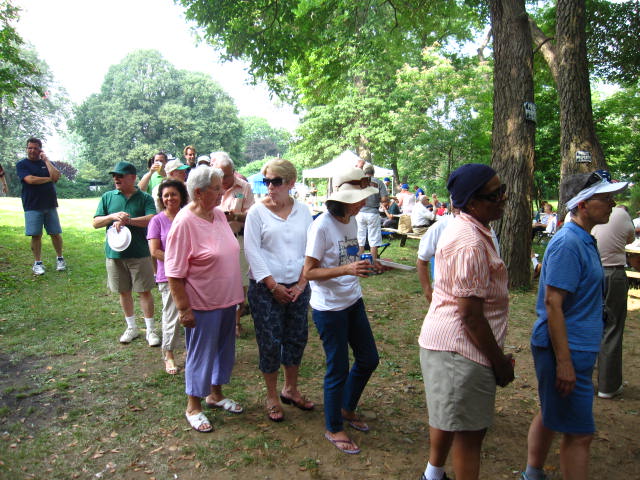
I have a confession to make: I know I shouldn’t have worried, but I did. The Pauline Family’s first annual St. Paul Friends & Family Fest was scheduled for August 7 on the grounds of the Society of St. Paul in Staten Island, NY, but the weather was clearly not on our side. The forecast promised 100% chance of precipitation, with heavy showers in the morning and thunderstorms in the afternoon. In fact, it had rained all night, so that by 8:00 Sunday morning the ground was soaked, it was still drizzling, and skies to the west were not at all friendly. People from Manhattan, S. I., and New Jersey began to call, so we had to decide what to do.

After we considered several options, we made our leap of faith. I wasn’t as daring as Brother Peter Lyne, SSP, co-organizer of the event, but so many people, religious and lay, had worked so hard, that it would have been a shame to cancel or postpone. Besides, what would we have done with all that food?

Amazing—not one drop of rain all day long! It was hot as blazes and a lot muggier, but if anyone complained I sure didn’t hear it. Sr. Carmen, novice director and provincial secretary in Boston, texted me to say they were all praying for us. So did Sr. Helena Burns in Chicago. Of course, she had a vested interest in the day: The proceeds were going to support the documentary she is working on about Blessed James Alberione, SSP, our founder. Still, it was thoughtful of her to remember us, so she deserved a phone call with the good news at day’s end.

About 125 people attended the noon Mass presided over by Fr. Jeffrey Mickler, who gave an insightful homily, as usual. He pointed out that in case any of us thought that documentaries were passé, let it be known that August 7 marked the twentieth anniversary of Madonna’s Truth or Dare. As a matter of Pauline Family history, it also marked the sixtieth anniversary of the inauguration of work on a different “Madonna” movie, San Paolo Film’s Mater Dei, the first color film in all of Italy. The silver screen still captivates us.

All told, approximately 200 people ate, played, and visited with each other throughout the afternoon. Five of the eight branches of the Pauline Family present in the U.S.—Sister Disciples of the Divine Master, Daughters and Pauline priests and brothers, Holy Family Institute members, and Pauline Cooperators—were all represented. After Mass we showed the preview of the Alberione film to those who wanted to watch and gave a little background. We then ran it on a loop, so that it showed continuously throughout the afternoon. It was set up in the cool basement of the SSP’s main building. So were the bathrooms. Nobody counted how many people really saw the film as they waited, or how often, but I think Fr. Alberione got plenty of attention.

Barbecuing in the heat and humidity was a heroic labor of love. Rolling Thunder Chapter 2 NY Staten Island bikers were those heroes. They’re members of a humanitarian organization that mainly supports U.S. vets…and they like to ride. Sporting their signature leather, tattoos, and hardware, they directed parking in the glaring sun and grilled hamburgers, hot dogs, Italian sausage, and chicken to perfection—and in incredibly good spirits. Between courses, they would take five to rest and chat. During one break they called me over to explain to them the difference between “the sisters in blue” (us) and “the ones in white” (the Sister Disciples). Then they wanted to know the difference between nuns and sisters. We had a great conversation.

Two of them came down to watch the film preview. One said he hadn’t been to church in so long that he was afraid the roof would cave in if he walked in. I can’t tell you how often I’ve heard that lame excuse, so I told him that the film in the basement would be a test run: If he survived that, he’d survive church. Halfway through the three-and-a-half minute showing, he got up, walked over to me and started asking questions about the Bible. At one point in our brief exchange, when I told him how Jesus didn’t have to die, but laid down his life “for you and for me,” he exclaimed, “I’m getting goose bumps!” Such a simple proclamation of the Gospel, but what an effect it had! It confirmed what I have long believed: No one can appeal to a lack of education as an excuse for not evangelizing. How many, sometimes without realizing it, are longing to hear the simple, core message of Jesus spoken in faith. How many opportunities we have to serve like that. If we pray, we will recognize those moments and, as Jesus promised, “what you should say will be given you….It won’t be you speaking, but the Spirit of my Father speaking in you” (Mt. 10:19, 20).

Back to the fest. Kids’ races, crafts, water balloons, and face painting made it fun for the under-12 set. The NYPD came to offer tours of its communications truck. People enjoyed themselves and each other. They ate to their heart’s content, told us stories of their connections to Staten Island or to this or that Pauline, and took chances on the 17 raffle baskets or one of the games. Early on, Hibernian Jimmy Haynes had to go out and buy more food. Clearly we had underestimated this crowd’s potential! We won’t know the total proceeds from the event until next week, but the generosity of the area’s business people, especially in this economic climate, widened the margin.


 The team who planned everything and kept things moving—none better! Most of them were recruited by Brother Peter Lyne. You know, if there ever is an award given for Networker of the Year, I’m nominating Br. Peter. If it hadn’t been for his connections, diplomacy, and dogged determination, it would not have gotten past the first meeting. Hibernians, Ladies Hibernians, Knights of Columbus, Columbiettes, Catholic War Veterans, and the scores of people they knew made it a real community day. Police Sgt. Brian and Patricia Reilly, Jimmy Haynes, and James Haynes IV, together with his wife Maria, constituted the central planning committee. Pauline Cooperator Marie-Louise Handal coordinated the promotion, and because of her, New York One TV aired its report on the event.

What made it news? The film, for one. It’s unusual. Who but James Alberione conceived of bringing a family to birth just to enter the media culture with the Gospel? But behind that is the nature of the event itself. This is the first time, certainly in my nearly 40-year Pauline memory, that we as a Family in the U.S. collaborated on a common outreach project. The Daughters and the Society collaborate often in publishing and distribution, but person-to-person contact—this is new.

Lastly, it gives us an opportunity to look forward in yet another way. Brother Richard Brunner, the representative of Fr. Silvio Sassi, superior general of the Society of St. Paul, had welcomed us all at the Mass, announcing that within a few days, the Pauline Family would begin its three-year preparation “in joyful anticipation” of the centenary of its founding. “August 20, 1914, is a date to remember because the Pauline Family was officially born. May this Mass and this gathering be the official start in the United States of our preparation for the centenary of our Pauline Family in 2014.”

He ended his remarks with the words of Fr. Alberione to the first young Paulines, so poor, so challenged, yet full of faith and hope. We listened, aware of our limitations, yet equally aware of our calling and our mission to share all we have from Jesus:

Foreground: Sister Disciples of the Divine Master

“Raise your eyes and look at this mighty tree [of our Family]—a tree so tall that its top cannot be seen. This is our Institute, which is truly a giant tree. You stand at the foot of a huge mountain; climb it and study the view. Your horizons are the world.”

Wednesday, August 3, 2011

In It Together

The weekend before last, I had the exciting task of attending the “triduum” or three-day retreat and conference of the Holy Family Institute in Canfield, Ohio and giving a presentation to this marvelous crowd. This organization is one of the foundations of Blessed James Alberione, SSP, founder of the Pauline Family. It consists of married people, often couples, who sense the Pauline charism within themselves and aspire to live the Christ-life as Paul the Apostle understood and lived it, while modeling their family life on that of Jesus, Mary, and Joseph. They make vows of poverty, chastity, and obedience according to their married state and raise their children in Gospel values, yeast in the dough of this media generated culture.

It’s always a treat to connect with “Family,” especially this bunch, with their enthusiasm, love, humor, and prayerful spirit. We had the added bonus of Fr. Mike Harrington’s leadership. He’s the first U.S. member of the Institute of Jesus the Priest (another institute of the Pauline Family—this one for diocesan clergy). It just so happens he’s also one of the chaplains to our FSP community in Boston. A young man exploring the Gabrielites—you guessed it, yet another  institute, this one for single men—dropped in for a visit. Of course, the presence of our brothers in the Society of St. Paul, especially the intrepid Fr. Tom Fogarty, who has accompanied the HFIs for years, was an indispensable gift. All these Family connections give a multi-faceted meaning to the word “mission.”

Fr. Fogarty, and
Fr. Ed Riley of Boston

We Daughters of St. Paul often refer to “our mission.” That’s what it is, but just as often we remind ourselves that it’s not ultimately “ours.” It’s really the Church’s mission of evangelization in which we participate, doing our part to sow seeds of the Gospel within the culture of communications, usually with the media themselves.

Actually, though, even the Church can’t claim this mission as her own. It’s been entrusted to her by her Lord; in fact, it’s his. Blessed Timothy Giaccardo, SSP, first vicar general of the Society of St. Paul, wrote this very thing decades ago, saying that it’s Jesus who preaches, Jesus who teaches, Jesus who carries out the mission in and through us. Yet even Jesus pointed to Another as the source of his mission: “My teaching is not mine, but his who sent me” (Jn. 7:16). Anointed by the Holy Spirit, Jesus Christ is the ambassador, “the Apostle,” of the Father, the “one sent” (Heb. 3:1). Who we are and what we do go way beyond ourselves, and we are amazingly privileged to be part of it. It’s “an apostolate that the angels envy,” Alberione would say.

Teen sons and daughters of HFI members gather
around that all-important text message.
This is why none of us has a corner on mission and why we are meant to work together, regardless of what aspect of evangelization we individually or communally happen to be engaged in. One of the hardest challenges to overcome is self-sufficiency. It leads even communities to isolationism, the “Lone Ranger” syndrome. I’m not sure it ever worked, but in our social media generated world, such an approach to mission definitely gets us nowhere today. Instead, collaboration is boon to everyone, in spite of the challenges and difficulties it presents.

This was the principal message in the presentation I gave on the second day of the triduum. It was part two of a series on the “Apostolate of the Cinema in the History of the Pauline Family.” What a fascinating story! Do you want to know what Mussolini’s favorite Pauline film was? Do you know which SSP movie was the first color film in Italy? What textbook was made into not one, but fifty films? More amazing even than that were the miracles that God accomplished among and through the faith of such pioneers when they worked together to evangelize with this modern medium of communication. Click here for last year’s presentation. Click here for this year’s.


Sr. Helena Burns gave a one-hour PowerPoint presentation to help the parents and grandparents in the Holy Family Institute to harness media and the media culture to grow themselves and to share their values with their families. She made a great analogy between media literacy education and driver’s ed. Just as no parent there would ever toss the car keys to their teen and wish him or her well without preparation, so no parent should expose young people to the world of media without teaching them to navigate it. Nor would they try to prevent their teens from driving at all, knowing that someday they probably would get behind the wheel. Just so, parents and grandparents could do much better than throwing out the TV or shutting out the media world, aware that outside their home, those same young people are faced with a huge number of media messages that require considerable discernment skills. “Control is for the moment; communication is for a lifetime.” If you’d like a copy of Sr. Helena’s PowerPoint presentation, e-mail her at helraphaelfsp@aol.com.

Sr. Mary Peter Martin teamed up with Sr. Marie James Hunt (whose parents professed their vows perpetually that Sunday) to lead the Eucharistic visit on Friday and Saturday. Both were beautiful experiences. Fr. Mike was definitely in his element and seemed to be everywhere: preaching, presiding at Liturgy, celebrating the sacrament of Reconciliation, receiving vows, and even joining Fr. Ed Riley, his classmate, in playing soccer with the kids and teens—in nearly 100 degree weather! Heroic.

You can see Fr. Jeff’s slide show of photos here. If you’d like more information about the Institute you can scroll down to my blog post of September 23, 2010. One of the members is beginning a blog for the Institute. Keep an eye on Pauline Faithways; once his blog is ready, I’ll be sure to let you know.
Photo credits: Fr. Jeffrey Mickler, SSP

Wednesday, July 27, 2011

Catch-Up

I'll be on vacation until next week, so you'll have some extra time to read any of those posts you haven't had a chance to read yet. See you on Wednesday, August 3!

Wednesday, July 20, 2011

“While I breathe I hope”: Promise in South Carolina

Bishop John England (1786-1842) must be glad we’re in his diocese. As the founder of the first Catholic newspaper in the U.S., as well as the parish-based Book Society, and as editor of a catechism plus a missal in English, the Irish-born bishop of Charleston, South Carolina, (how did he come by the name of England?) would appreciate the presence of sisters committed to bringing people to encounter Christ within the culture of modern communication. His diocese is still a mission Church, one that serves the entire state. In fact, Catholics comprise a little less than four percent of South Carolina’s population.

Jerusalem, you’ve got some competition. As signs of liturgical life, past and present, churches dominate the skyline of Charleston and so have earned it the name “The Holy City.” During the colonial period tolerance for every religion except Catholicism made it a spiritual hot spot, allowing even one of the oldest Jewish congregations in the country to thrive here.

Before
I imagine the city’s founders have made peace with Bishop England over the vibrancy of his Church here, though in our regard, not without a little wicked glee: In 1984 they must have prayed the Daughters into the charming historical building on King St.—a Class 5, the highest rating—headaches and all. The Siegling Family of German piano builders had opened one of America’s first music stores in 1838, and their edifice became ours. We think, though, that we have one up on them all: Neither they nor the founding fathers could have known that few shops would have been more appropriate for a community that would be known in various parts of the world for evangelizing through its music!

During
Following our arrival we adapted the space to our community and apostolic needs. In recent years, though, it became clear that a major restoration would be needed. Although our health and safety, as well as that of our customers and guests, was the immediate motivation for the change, the community also envisioned providing a way to ensure enough for both future maintenance and mission development. Meanwhile, another factor emerged. Nationwide, our health coverage became cost prohibitive, which drove us to drop it altogether. So the sisters visualize that fund helping to provide coverage for us in Charleston, besides something for basic living expenses. This way all income from the mission would go back into it. Normally, our evangelizing work provides for our personal and communal needs, but even with the ecumenical outreach that the sisters do, income in the mission territory of South Carolina is insufficient for their support.

After
So in 2006, after praying and asking others to pray, the four Paulines here set to work. By June last year they, their advisory board, their friends, and the Pauline Cooperators had raised $180,000 to restore and renew the exterior. Meanwhile they began exploring ways to raise funds for the next phase, which entails first, solidifying the floor in the book and media center and the several adjoining offices and rooms and replacing the carpet with wood laminate, more practical for a humid climate. The second goal links directly to the media nature of the mission. From its early configuration as a Catholic book store, the PBM (Pauline Books & Media) Center has metamorphosed into a center of spirituality and Catholic media resources in the heart of the city, the only one of its kind for hundreds of miles around, hosting several gatherings on a weekly basis, especially for young people. Thus, that second goal is to change one of those spaces into a state-of-the-art conference room that would be utilized for hosting Pauline ministry events, including some that could generate income. Price tag for both the floor and conference room: $125,000. There are still the living quarters to think of.

As the restoration and renovation work of one phase is being done, the next is being planned and budgeted so that funds can be raised. The most gratifying aspect of it all is the spirited involvement of everyone who has invested in it and built community with the sisters. They hold golf tournaments on the Isle of Palms or Daniel Island, that draw people from all over, or designate the community as the benefitting charity at the Nationwide Tour Championship. Volunteers staff Lydia’s Corner, an upscale consignment boutique in a section of the PBM Center. “Don’t even call it a second-hand store,” chided Sister Jane R. Livingston, the superior, aghast at my unforgiveable gaffe. “This is Charleston!”

With the Charleston community and its circle of friends,
Sr. Jane cared for her 57-year-old sister, Sr. Cecilia
Paula, until she died of cancer earlier this year. Sr. Cecilia
offered her prayer and suffering for every aspect of
her community's life.
Donors and collaborators feel that they’re the ones benefitting. “You don’t understand what we get from giving to you,” they say again and again. Sr. Jane comments, “They feel a part of the mission that will carry on into the future.” That mission includes the PBM Center’s weekly Bible classes for young adults, a young women’s faith sharing group called “Spirituali-Tea,” a women’s book club, and a weekly children’s story hour during the academic year, as well as offsite initiatives in parishes and schools. Sisters Clare S. Kralovic and Deborah Marie Dunevant will continue our Pauline presence here, while Sister Marie James Hunt joins them. A few months from now, Sister Jane concludes her second term as superior and will assist her parents in southern California. She considers as foundational her role in establishing with the Charleston team an infrastructure to stabilize our presence here: “I’m setting the chessboard. Whoever comes after me just has to play the game.”

Regardless of the camaraderie and collaboration, finding enough funds for such a project among just over four million South Carolinians is daunting. They can roll up their sleeves only so far. If you feel inspired to support their efforts, you can send your donation to:
The Daughters of St. Paul Building Fund
243 King St.
Charleston, SC  29401

Questions? Call 843-577-0175.

Pray for them and with them for those they serve, especially for other young women to carry their legacy into another generation. Where there’s life there’s hope. *

___________ 
* “While I breathe I hope” is one of the state’s two mottos.

Wednesday, July 13, 2011

Irrepressible Life

One question that we often get is, “So how are vocations?” Donors, no less than anyone else, look to the youth among us to gauge our community’s viability. While there are several reasons for a slump in any community’s numbers, understandably people want to support what they perceive as new life and a promising future.

Theresa and Laura after dinner dishes are done.
Life we’ve got. Our two novices here in Boston were joined last week by our four enthusiastic postulants from St. Louis, who are on summer break from their formal studies. These four young women had already become acquainted with us here as they began to discern their call from God before entering the congregation last year. Their postulancy is now introducing them more deeply to religious life and to our “version” of it, our charism, or our “color,” as the founder, Blessed James Alberione, sometimes described it. This two-year period assists each of them in the next step of their discernment and prepares them for their two years as novices, if that’s where their these years of formation take them.

Allow me to introduce you to:
Cheryl Galema, originally from the Philippines then from Toronto, Ontario
Jackie Gitonga originally from Nyeri, Kenya
Theresa Noble from Tulsa, Oklahoma
Laura Nolin from Newport, Vermont.

You can read up on each of them at their blog: Let Christ Be Formed in Me. Before you do, read on. I’ve got an exclusive for you! Just like the four evangelists—Matthew, Mark, Luke, and John—these four spoke about what God in Jesus is doing in their world and, as they told me about their lives, they inadvertently revealed something about themselves….

When Pad Thai isn't enough.
 What do you like best about being a postulant? Theresa: “The sense of adventure and never knowing what God has in store for you….” (Theresa says she would be up to “hiking through the Amazon” someday, but even more, “traveling by myself for a long time in India.” Adventure, all right.)
Jackie: “The combined experience of our apostolate, prayer and community life…has provided me with some pretty grace-filled moments to grow in love of God and neighbor.”
Laura: “I like the variety of people we meet and the many different ways we meet them through our apostolate.  We go out to some, and some come to us.”
Cheryl: “All the new things that I am able to do and discover about myself, like cooking. I wasn’t very comfortable in the kitchen because I was always afraid of burning myself or the house. Since I entered, I’ve helped cook a few meals and have recently learned to make Pad Thai. It was a hit!”

What’s one of the most challenging things for you?
Laura: “Living in community is probably the most challenging.  I really enjoy it most times, but sometimes it can be very difficult too.”
Cheryl: “Waking up early in the morning (and sleeping earlier than what I’ve been used to). Also, doing homework for our classes. It’s been a while since I was in school, so reading and writing papers have been challenging.”
Theresa: “There are a lot of interior struggles for me as I make these first steps of discernment in religious life. The inner wrestling with myself and with God is the most challenging.”
Jackie: “Community life, growing in love, stretching my heart to love all my sisters as well as people of God in ministry, just as Jesus does even with and through our differences.”

Our Boston community, centered as it is on the Pauline Books & Media publishing house, is dedicated primarily to the creative and technical phases of our mission. Some of us do carry out various forms of person-to-person outreach—book and media center, exhibits, and presentations—but the majority work behind the scenes. However, our branch communities, like St. Louis, serve people primarily one-on-one. A few years ago, it became possible to situate the postulancy there. Now it offers the young women in this early stage of formation a unique opportunity to share in the diffusion, or outreach, aspect of our mission. It gives them a chance to better understand what they’ll probably live for a good part of their lives, if they go on to profess chastity, poverty, and obedience among us. Maintenance, grocery shopping, scheduling, liturgy in common both with us and with the parish and archdiocese, and the countless details of life in a small community offer a more diverse experience of our Pauline religious life. Together with prayer and study, this is indispensable to them as they discern their vocations.

By the way, the novices also go for a similar stint several months during their formation. See Pauline Faithways of October 20, 2010 for Sylwia’s and Emily’s “apostolic experience.”

As Cheryl pointed out, study is a major component of the postulants’ days. In addition to theology courses at the accredited archdiocesan Paul VI Institute, they participate in other  seminars and, when offered, semester-long courses from the seminary. They receive their Pauline religious formation in house. At times, other Daughters of St. Paul are available to teach special intensive sessions, for instance, last year’s ten-day course on media literacy and the Church’s documents on media.

Most of these lively young women never imagined that they would be “on a journey to becoming a nun!” as Jackie put it, a journey that flies them to Boston each summer. The purpose for their month here is multi-faceted. They’re spending time in the motherhouse, reconnecting with our largest community in the US/ESC* province, which is home to a significant number of us. They get to spend time interacting with our elderly, senior sisters. Lastly, they’re introduced to the creative and technical phases of the mission.
Already in St. Louis, the postulants have had opportunities to sharpen their skills and acquire new ones. Instead of nursing, Laura, finds herself living “half-way across the country from the rest of my family,…occasionally doing public speaking” on vocation talks and J-Club school book fairs.
A former Web programmer and development team manager, Cheryl is amazed that she would pack “a van full of books and drive about 13 hours to Texas with a group of women who want to give their life to Jesus and talk to college students about…responding to God’s call to religious life.” (I don’t know why that should surprise someone who pictures herself climbing mountains or flying a hang glider!) Click here for the full story.
Now in Boston, Cheryl relates, “I’m working at digital [publishing]. Sister Kathryn and I are learning how to build an iPhone/Android app using a free online tool. There’s a lot of trial and error in the process, but it’s really fun. I’m also helping with getting the Web site redesign moved along. I used to build Web sites, but a lot has changed, and the tools we’re using are different. I also don’t have very much experience in layout and design, so I’m learning from the rest of the team.”
Previously a systems analyst in San Francisco, Theresa seconds that and adds:
“Before I came to the postulancy I was working for a corporation with tons of resources. It is very different here; we have really limited resources. It becomes an exercise in creativity to work on the cutting edge. But the challenge is exciting, and knowing that God is right behind us inspiring our work and our ideas makes it really rewarding.”
Laura doubles as an assistant to Sr. Patricia in the Web store, and a sales associate in the PBM center in Dedham, a town just outside Boston. She confides:
With a picking ticket in one hand
and books in the other, Laura fills
a Web store order.

“The book center is good in that it’s helping me with my people skills (I tend to be shy), but it’s also helping me be even more confident in the things I already know about the book center. The Web store will stretch me a lot. I only know the basics when it comes to computers, so it will take a lot more brain energy. The learning curve will be steep, but I’m looking forward to learning something new.”

With Sr. Rebecca behind her, Jackie
prays for the people she met at the
PBM Center that day.
 Having earned her doctorate in human resource education right before joining the congregation (You’d never know that her secret dream is to drive an 18-wheeler), Jackie also appreciates working in both the Web store and PBM center:
“Both require people skills in different ways—face-to-face in the book center and behind the scenes [with] good customer service in the Web store. In these apostolates, I am constantly being drawn to find ways that I can bring people to Jesus by reaching out to them with utmost charity. I am also growing in my technical skills of running the Web store. In the book center, I am learning about the design and ambiance—creating an even better place where people can encounter the Lord through the media we provide.”
In case you couldn’t tell, they’ve got high hopes for the future:
Jackie: “There is such depth, breadth and height to the calling we have received as Daughters of St. Paul—to bring Jesus to all peoples using the most modern means—that I think its only going to get better and I would certainly want to be a part of it!”
Laura: “The Daughters of St. Paul are always willing to change to meet the needs of the people according to the times when it comes to evangelization and at the same time they hold fast to the teachings and traditions of the Church, that are timeless and never changing.”
Theresa: “I visited a lot of different congregations and the thing I was impressed the most about the Daughters was their reliance on God amidst a busy apostolate. It is so tempting to begin to rely on your own abilities and intelligence and to forget God’s part in it all. I do not see this playing out in the Daughters. I think this is partly because their mission is so immense, not many people would make the mistake of thinking they could tackle it on their own!”
Cheryl: “Our founder, Blessed James Alberione, had one love—Jesus Christ, and one mission—to give him to souls. I can see the sisters live this with joy and passion, even with the difficulties that they have faced through the years. It is obvious that the Lord has blessed our community tremendously and continues to do so.”
Sister Rebecca Marie Hoffart, originally from Houston, has been the postulant director for the past three years. She has a full plate, not because the postulants are all that tough to work with, but because she’s continuing her own education at the same time. She recently earned a certificate in spiritual direction, and now her Master’s degree in Christian Spirituality from Creighton University is actually within reach; she hopes to finish her thesis within the next year. So the hope the postulants expressed is not only theirs. “It’s incredible to see the Pauline charism blossoming in them,” Sr. Rebecca shared, “to see them growing closer to God, getting to know the founder and his writings, resonating with the spirituality and mission. They have a lot of hope in our mission, because they see how necessary and how vast it is, how it reaches people and how important it is.” She speaks for us all.

You’ll see on the postulants’ blog the photo of a fifth young woman, Erin Nolan, who had been a postulant this past year. The discernment process is doing what it’s designed to do also for those who do not stay: Over the past few months, Erin and the formation team realized that God is calling her elsewhere. She left with deep affection for the community—and the community’s lasting affection for her.

Laura and Jackie will enter the novitiate this August, as Emily and Sylwia become second-year novices. We’re delighted to welcome three new postulants in September, young women whom we’ve known for a few years. Two of them were frequent participants in our summer discernment programs. So that means four novices and five postulants will bring their irrepressible life among us. If you would like to donate to their formation program this coming year, click here. Sr. Rebecca is hoping to raise $6,000 for projects and specialized courses for them, so that they might continue to be a sign of the life that has nurtured them here.
___________
* United States/English-Speaking Canada

Wednesday, July 6, 2011

Independence, Freedom, and Same-Sex “Marriage”

Boston is a great place to celebrate the Fourth of July. Along with most of the population, we relax in the warmth of midsummer by day and revel in fireworks and the Boston Pops by night—and with good reason. It’s the birthplace of America’s experiment as a democratic republic. Without the ideology of New England forged within the crucible of the Mother Country’s reactionary policies and without the relentless prodding of Boston’s John Adams, the Declaration of Independence would never have even made it onto paper. Even so, every colony paid a heavy price in the Revolution that followed. We are the beneficiaries of their largesse.

I wonder what they would have said about New York two weeks ago when same-sex “marriage” became legal. When I was a girl I thought that freedom meant I could live the way I wanted to. Of course, that idea came from history class, as we studied a nation’s liberation from a foreign ruling power. But I personalized the notion, so that as a teen I longed to break “free” of home, to run my own life. Need I say that the reality of adult responsibility was a rude awakening?

Independence Day came early for New York’s LGBT citizens. The legalization of same-sex “marriage” may have signaled a new independence, but not necessarily a new freedom. Our nation’s founders knew and practiced enough philosophy to make a distinction between the two and between freedom and license. Philosophy, however, wasn’t a major factor in the campaign for marital equality for gays. In contrast to a reportedly disorganized religious and civic opposition, an astute political plan and extraordinary funding, plus emotions and family ties, drove the vote that ended 33 to 29. (See the June 26 issue of the New York Times.) I’m not sure that there’s a family or circle of friends among us that doesn’t feel torn on the issue because of a gay or lesbian relationship in its midst. Still, with most of the country bracing itself for a similar firestorm, it’s worth searching for some clarity that can help us all.

I wonder how many people realize that when we opened the door to contraception, this controversy was inevitable. As nothing else, contraception divides the unitive and procreative purpose of marriage, or as the U.S. bishops mercifully chose to say, its love-giving and life-giving aspects (To Live in Christ Jesus: A Pastoral Reflection on the Moral Life). Once marriage is cast in terms of “love” without openness to generating life, any loving union between consenting adults can then qualify as “marriage.” Just to be really clear, when the bishops said “life” they weren’t referring only to its cultural, spiritual, or social dimensions, but to children generated by that union. This doesn’t imply that there shouldn’t be any family planning or that childless couples are not living a true marriage. It does say that, to be what it’s meant to be, the couple’s relationship has to be structured and lived in such as way as to welcome the possibility of new life.

Jeff Jacoby
Advocates for same-sex marriage are now taking as their heroes Mildred and Richard Loving, whose case led the Supreme Court to legalize interracial marriage in 1967. Last Wednesday Jeff Jacoby, a columnist for the Boston Globe, took a swipe at the way these two moments in history are being linked. In perhaps the clearest, most cogent opinion I've read on the topic, he commented that because the state of Virginia, representing the status quo, had penalized interracial marriage, it had been in fact attempting to change the meaning of marriage. Far from denying that meaning, as the New York “law” has done, the Supreme Court’s decision on interracial marriage “affirmed it”* and restored its integrity in the public sphere. The state of Virginia had skewed the purpose of marriage to “promote white supremacy, a value completely alien to marriage. Marriage is designed to bring men and women together; anti-miscegenation laws frustrated that design….”* While gay and lesbian dignity must be protected in law, skewing the truth about the human person or human society does not ensure anyone’s dignity or freedom, not even theirs.

I’ve been meditating a lot these days on the words and actions of that champion of freedom, the Apostle St. Paul. With his sometimes flaming rhetoric, he traces out a few key themes:
1. Freedom from sin through faith in Christ. This is probably the aspect he’s best known for. As a sacrament of faith, Baptism effects that freedom through the power of the Holy Spirit and inserts us into the body of Christ as sons and daughters of God. We are freed from our sins, freed for faith, hope, and love in Christ and in the Church, the liberated People of God. “For freedom Christ set us free” (Gal. 5:1).
2. Freedom to be who God made us to be, with our potential, gifts, and relationships. This launches us light years away from just what we think we want to be, especially when what we want is contrary to what the God of love desires for us. Our best plans for ourselves pale in comparison with what marvels God has in mind. “What no eye has seen and no ear has heard, what the mind…cannot visualize, all that God has prepared for those who love him” (1Cor. 2:9).
3. Freedom to grow in our humanity, which is what Christianity empowers us to do when it’s really lived. We become truly human as God intends. We shed what “makes us wobble” in our humanity, as one sister put it to me this week, and grow in “maturity, to the measure of the full stature of Christ” (Eph. 4:13). Each of us can probably point to something that would make us better persons—a course of study, a bad habit put to rest, an improved relationship—but because we’re shackled by something else (sometimes even by what we want)—circumstances, a compulsion, our weakness—we’re not free enough to do it. Clearly, then, freedom pertains to something other than our less-than-human desires. The social implications are just as clear.
In his book, Jesus of Nazareth, Benedict XVI offers his own insights into a freedom, not arbitrarily or subjectively determined, but a “seeing” freedom, with “our eyes fixed on Jesus” (Heb. 12:2).

Now, that’s fine for Catholics. But society consists of people from many faith backgrounds. How does religion factor in without imposing itself?

Every social issue is a moral issue that bridges religious divides. As a recognized moral authority, even in spite of the damning events of the last decade, the Church weighs in on what undergirds political solutions, even though it may not be partial to the solutions themselves. Even-handed pastors of other persuasions do the same, because they have both a right and a responsibility to. By the way, the Church’s leaders and teachers are also voters with opinions that can be and should be legitimately expressed. I remember Cardinal O’Connor writing in the Catholic New York about thirty years ago that he didn’t mind being beaten in the ring. Just don’t tell him he has no business in the ring!

Unfortunately in New York last month—and way before last month—the Church dropped the ball. That ball may be in the bishops’ court, but we’re all there with them. Like the rest of us, they’re overwhelmed by their responsibilities in an incredibly complex society and find that they spend a large part of their time just putting out fires. As Church we are still too accustomed to leaving the Big Issues of the day for them to handle, while the rest of us content ourselves with managing our own concerns.

They need our help. First, we all need to study how our contemporaries think and to accept the fact that the strict rules of logic are not completely compatible with the postmodern way of reasoning and emoting. Once we accept that, we can set about making ourselves better understood, not by tossing logic aside, but by finding a person’s tap root, and feeding it with what makes sense to us together. For instance, you and I may agree that a compelling reason for accepting a teaching of the Church (read: “marriage”) is its tradition that is thousands of years old. To a postmodern person whose reference points do not include history or authority, but the effort to be a better person or to make this world a better place now, our starting point will have to be centered on the truth we hold in common. Then our logic can be heard. Then we can craft our witness to the Gospel accordingly, with courage, creativity, and fidelity. A readable book in this vein is Secularity and the Gospel: Being Missionaries to Our Children, edited by Ronald Rolheiser. Cardinal Francis George of Chicago contributed one of the essays.

Second, we need to be proactive in deepening our understanding of faith in its particulars, not waiting to be spoon fed, so that we will readily recognize truth when we hear it and so that our moral/spiritual discernment can be honed. Too often sound bite theology or feel-good stories suffice for our exploration of faith. Then when weightier issues elbow their way into our lives, we have nothing to fall back on (cf. Mt. 7:24ff.).

Finally, we need to learn the language of media. Without a doubt the digital revolution has had a lot to do with our contemporaries’ insistence on moral self-determination. With the advent of social media, suddenly the speaker’s podium became accessible to anyone, informed or not. Together with situations once considered taboo that have been “normalized” on TV and film, this accessibility has conditioned people to relativize authority and adhere to their own standard of truth.

Forgive me if, in the light of this, I tuck in an appeal for the Education Fund on behalf of our sisters, who are working toward both their liberal arts degrees and advanced specialization. Our studies prepare us to do just what I described (and prescribed), to help prepare our people—God’s People—for all that lies ahead. Click here to learn more and to donate. As the weeks go by, I’ll be telling you more about this year’s Afternoon Tea with the Daughters of St. Paul, our annual fundraising event to support this cause.

May our families and neighborhoods be the “home of the brave” as we gently yet boldly witness within them to the truth that sets us all free.
__________
* © 2011, The Boston Globe